How SpaceX streamlined the Raptor engine
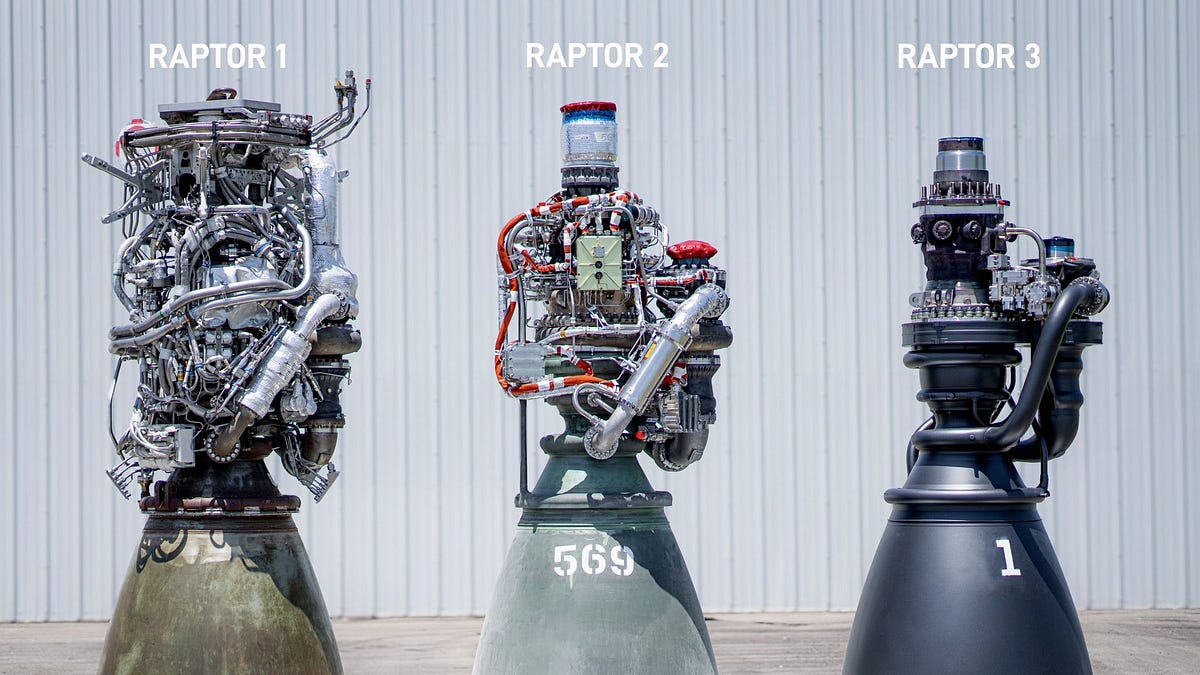
The item examines the evolution of SpaceX's Raptor engine, which powers Starship; Falcon 9 and Falcon Heavy use the Merlin engine instead. Raptor was first test-fired in 2016, first flew on Starhopper in 2019, then flew on a Starship prototype in 2020 and on the full Starship stack in 2023. It has continued to improve since, moving from the tangle of pipes and wires on Raptor 1 to the smooth, streamlined design of Raptor 3, which first flew in May of this year.
The visual change was so dramatic that many initially believed it was not real. Tory Bruno, then-CEO of United Launch Alliance, tweeted that there was no need to exaggerate this by showing a partially assembled engine, after which SpaceX president Gwynne Shotwell tweeted a picture of Raptor 3 firing successfully.
The streamlining has come with meaningful performance gains: Raptor 3 provides about 35% more thrust than Raptor 1. The author wanted to understand what specifically SpaceX changed to go from the tangled early version to the svelte later engine.
There turned out to be less detail available than the author hoped. SpaceX does not publish official Raptor schematics, and no one has done a teardown of a Raptor engine. But occasional comments from Elon Musk and speculation from SpaceX fans provide some idea of the major changes.
The Raptor engine is a full-flow staged combustion engine. To explain what that means, the item starts with rocket propulsion basics: a rocket engine works by throwing mass, called propellant, out of a nozzle. By Newton's Third Law, that action pushes the rocket in the opposite direction. The more mass thrown out and the faster it is thrown, the more thrust the engine produces.
The simplest rocket is a cold gas thruster: a tank of pressurized gas vents gas to propel the vehicle, similar to letting air out of a balloon. Such thrusters are simple and reliable and are used for minor position or orientation adjustments, including on NASA's Manned Maneuvering Unit and Falcon 9's control thrusters. They are limited in how much thrust they can practically produce.
To get more thrust, one obvious approach is to use two propellants, such as a fuel like kerosene and an oxidizer like oxygen, and burn them together in a combustion chamber. That creates hot gas that escapes out the back of the rocket nozzle. The excerpt then begins to explain that this changes how the engine uses energy compared with simply venting pressurized gas.