Rare, Widespread Snow in the Atacama Desert
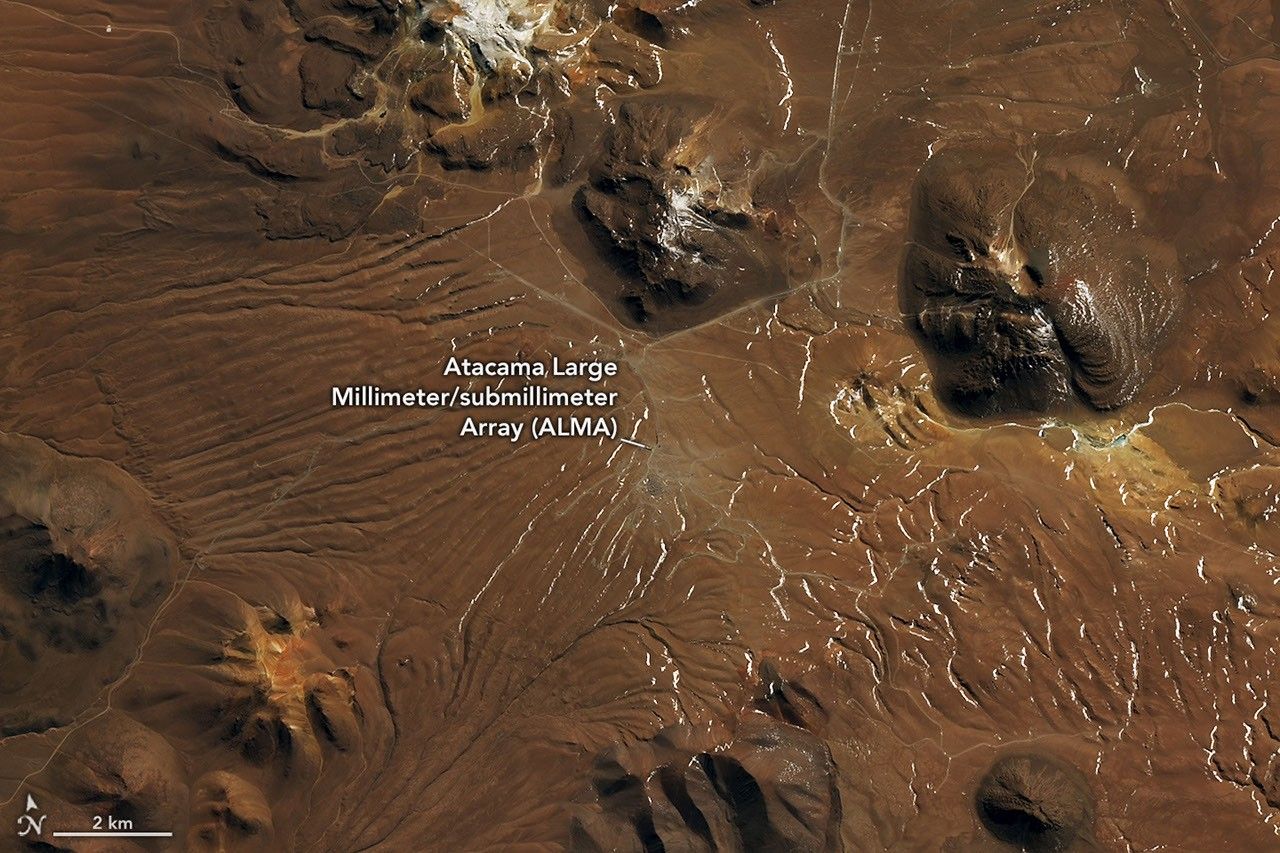
In August 2026, back-to-back winter storms left parts of the Atacama Desert in northern Chile covered in a rare blanket of snow. The typically arid region has seen snowfall before, notably in 2025 and before that in 2011, but one of the 2026 events was unusually widespread, stretching from the Andes to near the Pacific coast.
The NASA-USGS Landsat 8 and 9 satellites' OLI instrument captured before-and-after images on August 6 and 14, showing the Chajnantor plateau within the Altiplano-Puna volcanic complex, home to the Atacama Large Millimeter/submillimeter Array (ALMA). As snow and high winds set in, ALMA suspended operations and moved its antennas into a protective survival mode. A second storm in the second half of the month blanketed an even wider area; MODIS on NASA's Terra satellite captured an image on August 19 showing snow extending from the Andes across the hyper-arid core and close to the Pacific coast south of Antofagasta. Several other major astronomical observatories in the coastal area also suspended operations.
The region's winter precipitation typically comes from cutoff lows—low-pressure systems cut off from the jet stream. The late-August 2026 storm also came from a cutoff low, but this one spun off from an unusually large trough spanning from the tip of South America into the subtropics. Combined with ample coastal moisture, it produced precipitation over an unusually wide swath—offshore, along the coast, across the core of the Atacama, and over the Andes. Totals reached a magnitude 'rarely seen in the otherwise extremely arid region,' according to atmospheric scientist René Garreaud. In some areas it fell as rain; Taltal on the northern coast accumulated nearly 40 millimeters (1.6 inches) in three days—about 10 times its annual mean. Garreaud noted, 'We see these kinds of events only a few times, if any, per decade.'
The abundant precipitation spurred destructive mudflows and flash flooding. The National Disaster Prevention and Response Service (SENAPRED) reported thousands affected and hundreds of homes with major damage.