Europe’s Scorching Summer
Western Europe experienced its first hint of an unusual summer in May 2026, when a heat dome produced exceptional temperatures that shattered records in several countries. By mid-August, the region was enduring its fifth heat wave of the season, with temperatures well above 40°C (104°F) across a broad area. The heat persisted for days or weeks, often remaining overnight, and upended daily life: hospitalizations and heat-related deaths spiked, highways and train tracks buckled, large wildfires raged, and a severe drought worsened to record-low river levels, disrupting water, power, transportation, and agriculture.
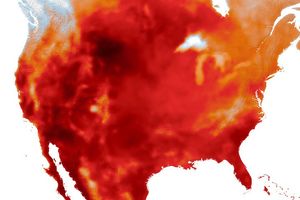
The animation above shows daily maximum surface air temperature across Western Europe from May 1 to August 19, 2026, produced by combining satellite observations with NASA’s GEOS global model, which uses mathematical equations to represent atmospheric processes. Darkest red areas indicate where temperatures met or exceeded 40°C.
Records fell at a furious pace. According to the UK Met Office, London hit 35.1°C (95.2°F) on May 26, smashing the previous May record by 2.3°C (4.1°F). Bordeaux, France, broke its maximum-temperature record on three consecutive days, reaching 42.5°C on June 24, as reported by Météo-France. Slovakia set new national records for both daytime and nighttime highs in August, and combined June–July temperatures in Western Europe were the highest on record, according to Europe’s Copernicus climate monitoring service.
Extreme heat collided with vulnerabilities such as limited air conditioning, high nighttime temperatures, and a lack of green space in some cities, triggering heat exhaustion and heatstroke. Preliminary reports suggest heat may have been associated with 10,000 excess deaths, including thousands in the UK, France, Germany, and Belgium. As Anamika Shreevastava of New York University, who studied urban heat islands at NASA’s Jet Propulsion Laboratory, noted, “Air conditioning is an especially critical issue in Europe in the short term.”