The Otherworldly Geology of Vasquez Rocks
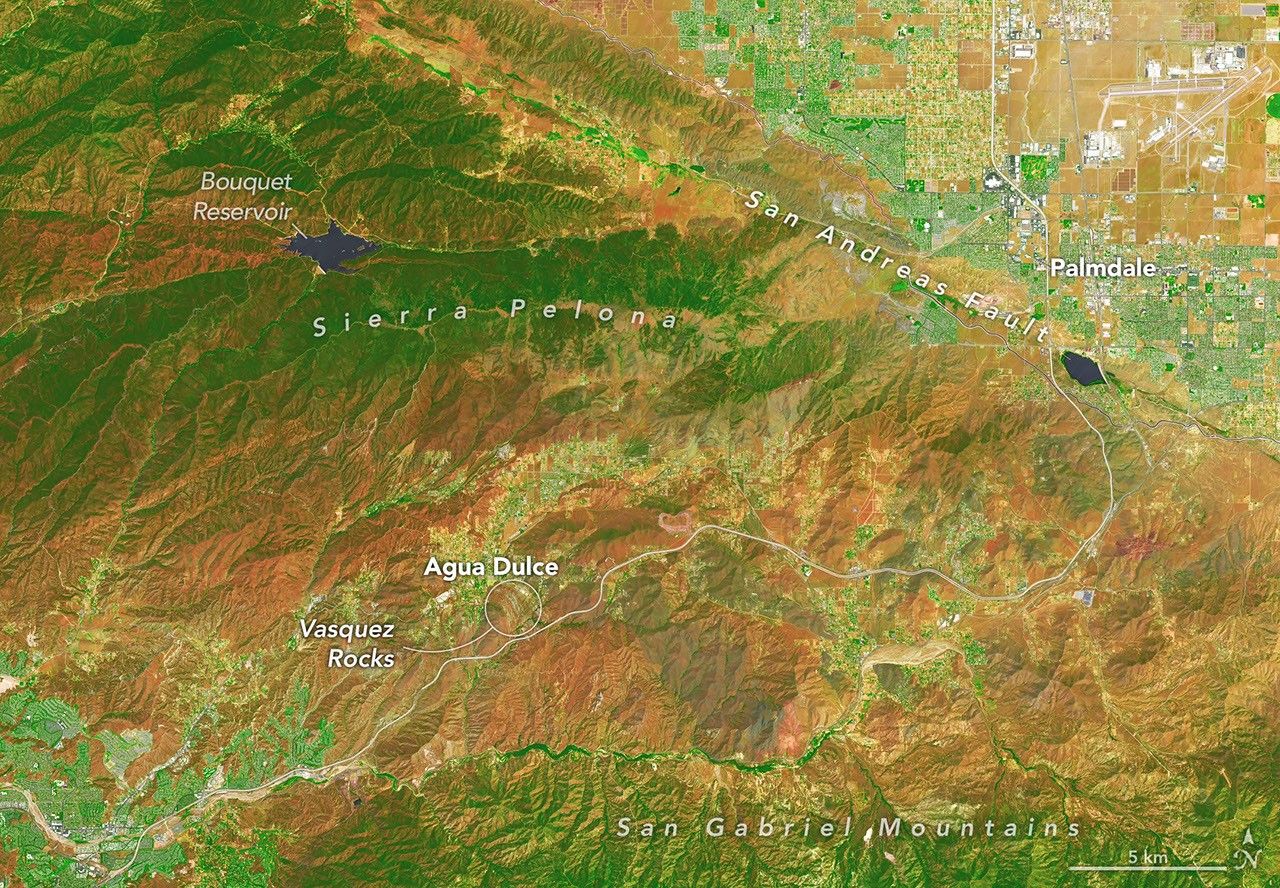
Vasquez Rocks Natural Area in Southern California's Soledad Basin features layers of sedimentary rock tilted at an average of 50 degrees, steep enough that many formations seem to point skyward. Known as the answer to the September Puzzler, these rocks have served as a backdrop for Star Trek since its inaugural season, including the classic fight between Captain Kirk and a reptilian alien.
The rocks are less dramatic from orbit, but they appear as gray bands between mountain ranges in two new images from the Operational Land Imager (OLI) on Landsat 9. A false-color view (bands 6-5-4) incorporates shortwave-infrared and near-infrared observations that accentuate differences in vegetation, while a natural-color image on the right shows the scene as the human eye would see it.
The geological story began about 25 million years ago, when sediment eroded from nearby uplands was spread across alluvial fans—cone-shaped deposits formed as fast-moving streams emptied onto relatively flat plains. Over time, the deposits were buried and cemented into thick layers of sandstone and conglomerate rock. Later, tectonic activity along the San Andreas Fault—a strike-slip boundary where the Pacific plate moves northwest relative to the North American plate—uplifted and deformed the Soledad Basin, gradually tilting, folding, and rotating the layers. After exposure, millions of years of weathering and erosion sculpted the formations, removing softer material and leaving the resistant fins and ridges seen today.
Beyond the original Star Trek episode, the rocks have represented far-flung planets in other episodes and Vulcan in two Star Trek movies. They also appear in dozens of other productions, including Westworld and For All Mankind.