NASA’s Webb Provides Crash Course on Planet-Shattering Collisions
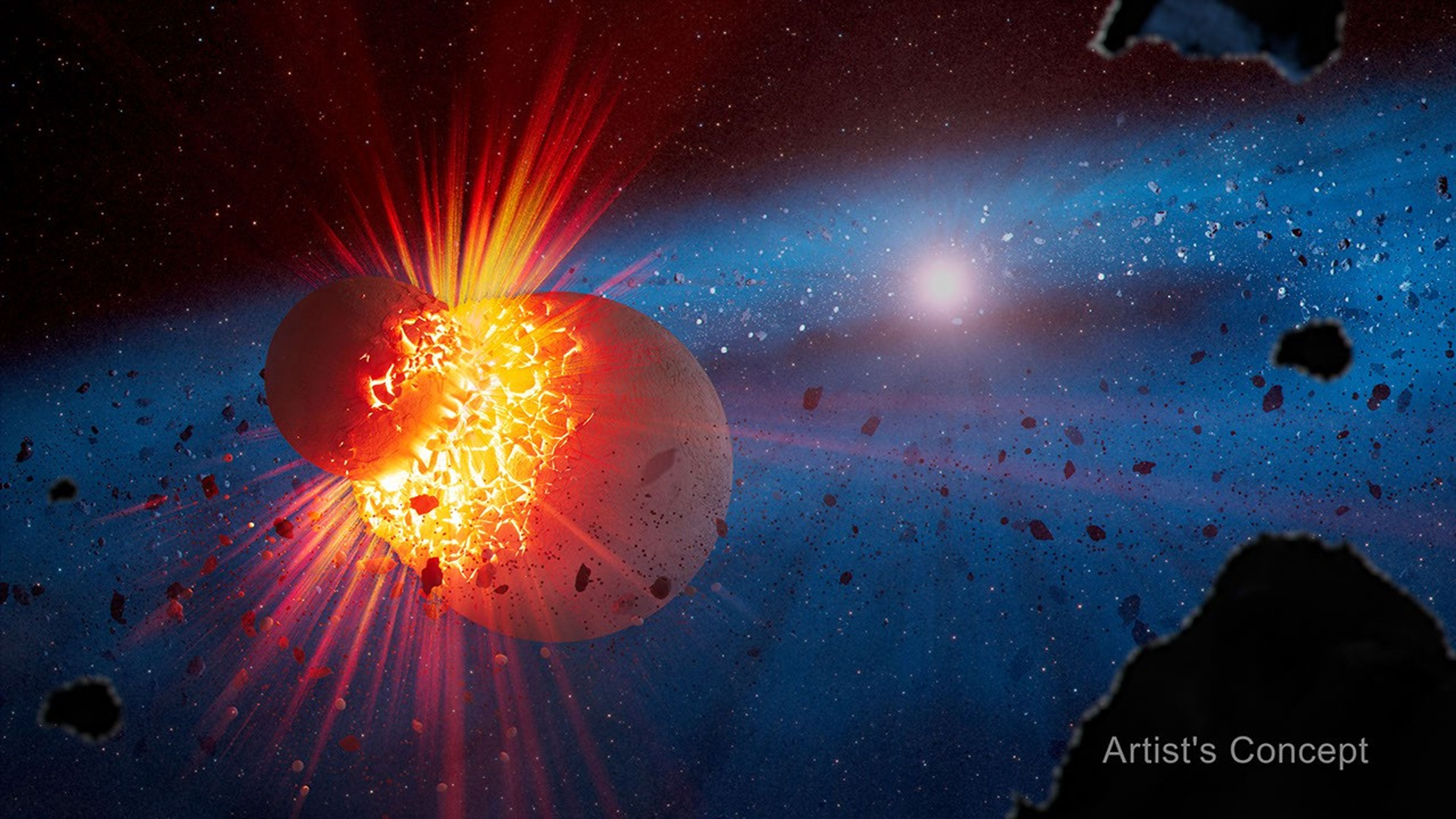
In the early solar system, scientists theorize that a Mars-sized object called Theia smashed into the infant Earth, vaporizing massive amounts of rock and blasting it into space; some of that material coalesced into the Moon. NASA's Artemis program is returning humans to the Moon, preparing for Mars, and shaping the future of space exploration, while that long-ago collision reshaped our home planet. Astronomers have now used NASA's James Webb Space Telescope to examine a class of young stellar systems showing signs of similar upheavals, providing clues to the amount of energy in their collisions and insights into the composition and evolution of these chaotic systems. The team's findings were published Thursday in The Astrophysical Journal.
The collisions occur in young stellar systems known as extreme debris disks, which are relevant to understanding our own solar system and the similar impact events thought to have created the Moon and shaped Earth's initial state. As a star ages, its environment changes from a juvenile, gas-rich protoplanetary disk where forming planets can reside to a gas-poor debris disk. During its mission, NASA's retired Spitzer Space Telescope examined the debris disk stage and discovered the extreme debris disk subclass; these systems harbor unusually large amounts of warm dust close to the star, in the region comparable to where rocky planets orbit in our solar system. A team of astronomers led by Kate Su of the Space Science Institute in Boulder, Colorado, investigated these objects with Webb. Contrary to theoretical predictions that many extreme debris disks should be observed, observations indicate these environments are rare: scientists estimate roughly only 1% of young stars show observable signatures of this phase based on data collected so far, including possibly our own solar system during its formation.
Despite their rarity, the team compiled a sample of 21 extreme debris disks, including five from Spitzer's archival data and 16 from Webb, with 12 newly observed disks and follow-up observations on four of Spitzer's. "This is the first time we have gathered enough systems to truly understand this subclass that we call extreme debris disks," said Su, lead author of the paper. "Before Webb, we had limited information. We knew that they are weird and very different from the typical cold debris disks that we know, like Vega and Fomalhaut. Now that we have more data, we can pin down what these disks represent for planet formation and evolution." The team confirmed that extreme debris disks share three key properties: smaller dust grains than those in protoplanetary or classic debris disks, a high concentration of warm dust, and irregular brightness variations, all revealed by mid-infrared spectra from Webb and Spitzer.