NASA Awards First Prize in Phase 2 of Agency’s LunaRecycle Challenge
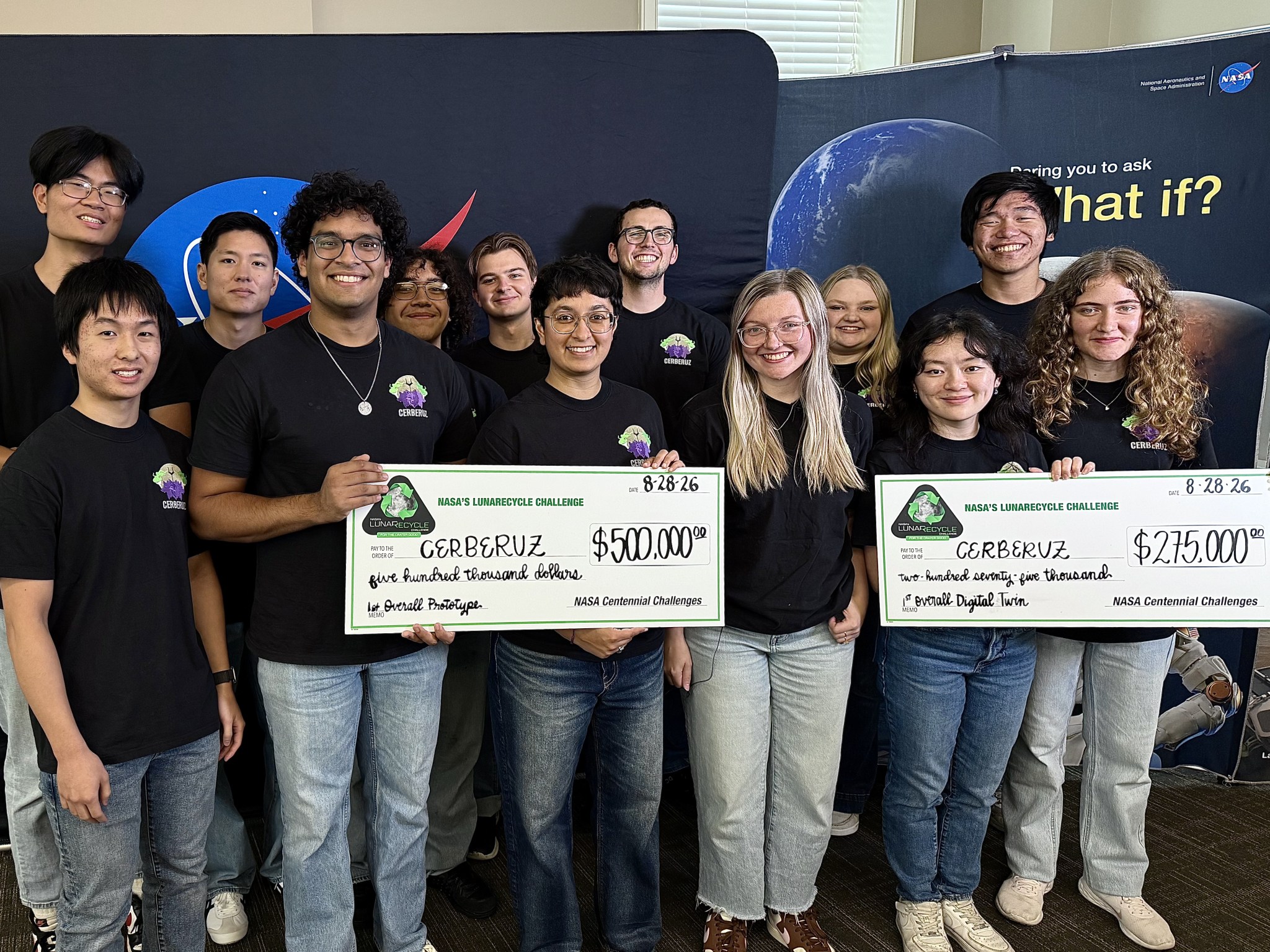
NASA has named MIT's CERBERUZ team as first prize winner of Phase 2 of the LunaRecycle Challenge, a competition targeting waste reduction during Moon or deep-space missions by recycling common materials such as fabrics, plastics, foam, and metals. LunaRecycle is a $3 million, two-phase competition run in partnership with The University of Alabama Lee J. Styslinger Jr. College of Engineering. Phase 2 required U.S. teams to submit a prototype, with an optional 'digital twin' virtual model. Fourteen finalist teams from across the U.S. gathered at the University of Alabama in Tuscaloosa from Aug. 24-28 to demonstrate their prototypes, with digital twin models presented alongside.
MIT's technology grinds mixed trash into a fine powder, repurposing materials like Zotek foam as reinforcement rather than treating it as contamination to be sorted out; the powder becomes feed for injection-mold finished parts or 3D-printing filament. The CERBERUZ team, made up of undergraduate, graduate, and doctoral students, won in both the prototype development track and the digital twin track, receiving $775,000 total.
Alongside MIT's first prize, nine teams received awards: in the prototype track, Terasynth of Orlando took second place overall ($225,000) with the Lunar Re-Forge System; RECLAIM from Penn State won Most Innovative ($50,000) with the RECLAIM system; Cislune of Rosemead, California won Highest Mass Efficiency ($50,000) with the CRAFTER system; and Team Lovegrove from Bob Jones University won Most Trash Types Recycled ($50,000) with LunaBrix. Additional digital twin track winners included a second-place overall award of $125,000 to Moon M...
Jennifer Edmunson, program manager for Centennial Challenges at NASA's Marshall Space Flight Center, called the finale 'the culmination of two years of innovation spurred by this competition,' noting it was 'incredible to see these technologies go from concept to prototype and digital twin demonstrations in that time.' Teams were encouraged to envision solutions that could also have applications on Earth, and competitors ranged from university students and faculty to entrepreneurs and space technology enthusiasts.