NASA Welcomes Albania as Newest Artemis Accords Signatory
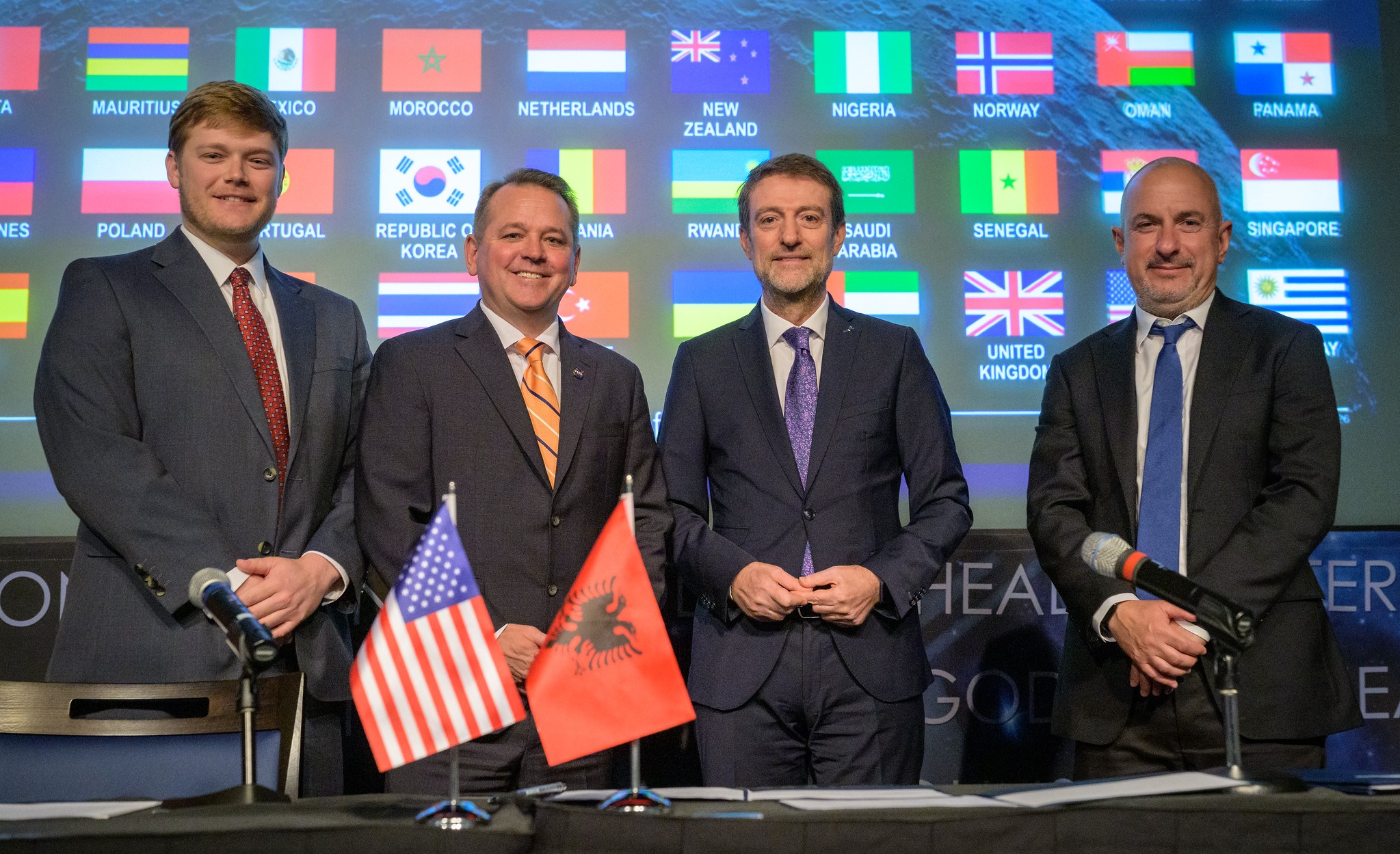
Albania signed the Artemis Accords Monday during a ceremony hosted by NASA at its Washington headquarters, becoming the 73rd signatory and joining the coalition of like-minded nations committed to responsible and transparent space exploration. NASA Deputy Administrator Matt Anderson said it was his privilege to welcome Albania as the 73rd signatory, noting that the relationship between the two nations goes back more than a century and that the partnership is now being extended into space. Albania’s Minister for Europe and Foreign Affairs Ferit Hoxha signed on behalf of the country, and Ambassador Ervin Bushati and U.S. Deputy Assistant Secretary of State for Space and Environment Connor Tomlinson also participated.
Hoxha said it was a great honor for Albania to join the growing community of Artemis Accords nations. He stated that by taking this step, Albania affirms its commitment to peaceful, transparent, sustainable, and cooperative exploration of space, doing so as a country deeply committed to international law, multilateral cooperation, and the belief that humanity’s greatest achievements are realized through partnerships rather than isolation.
Albania’s space efforts include the launch of two dedicated Earth-observation satellites, Albania-1 and Albania-2, in January 2023 aboard a SpaceX Falcon 9 rocket from NASA’s Kennedy Space Center in Florida, an example of U.S. support for Albania’s space capabilities. Albania has also played an active role in NASA’s Space Apps Challenge, hosting local events that connected students, technologists, and innovators with NASA’s openly available Earth and space science data. NASA Space Apps is the world’s largest annual global hackathon, mobilizing participants in more than 150 countries to develop solutions to real-world challenges using open data from NASA and partner space agencies.
In 2020, NASA and the State Department joined with seven other founding nations to establish the Artemis Accords, responding to growing interest in lunar activities by governments and private companies. They introduced the first set of practical principles aimed at enhancing safety and coordination as nations explore the Moon, Mars, and beyond, committing nations to explore peaceably and transparently, render aid to those in need, enable access to scientific data, ensure activities do not interfere with those of others, and preserve historically significant sites and artifacts by developing best practices. By signing the accords, nations open the door to opportunities for future lunar exploration with NASA, advancing humanity’s return to the Moon and shaping the Golden Age of space exploration and innovation.