Powerful Storms Continue to Prowl the Pacific
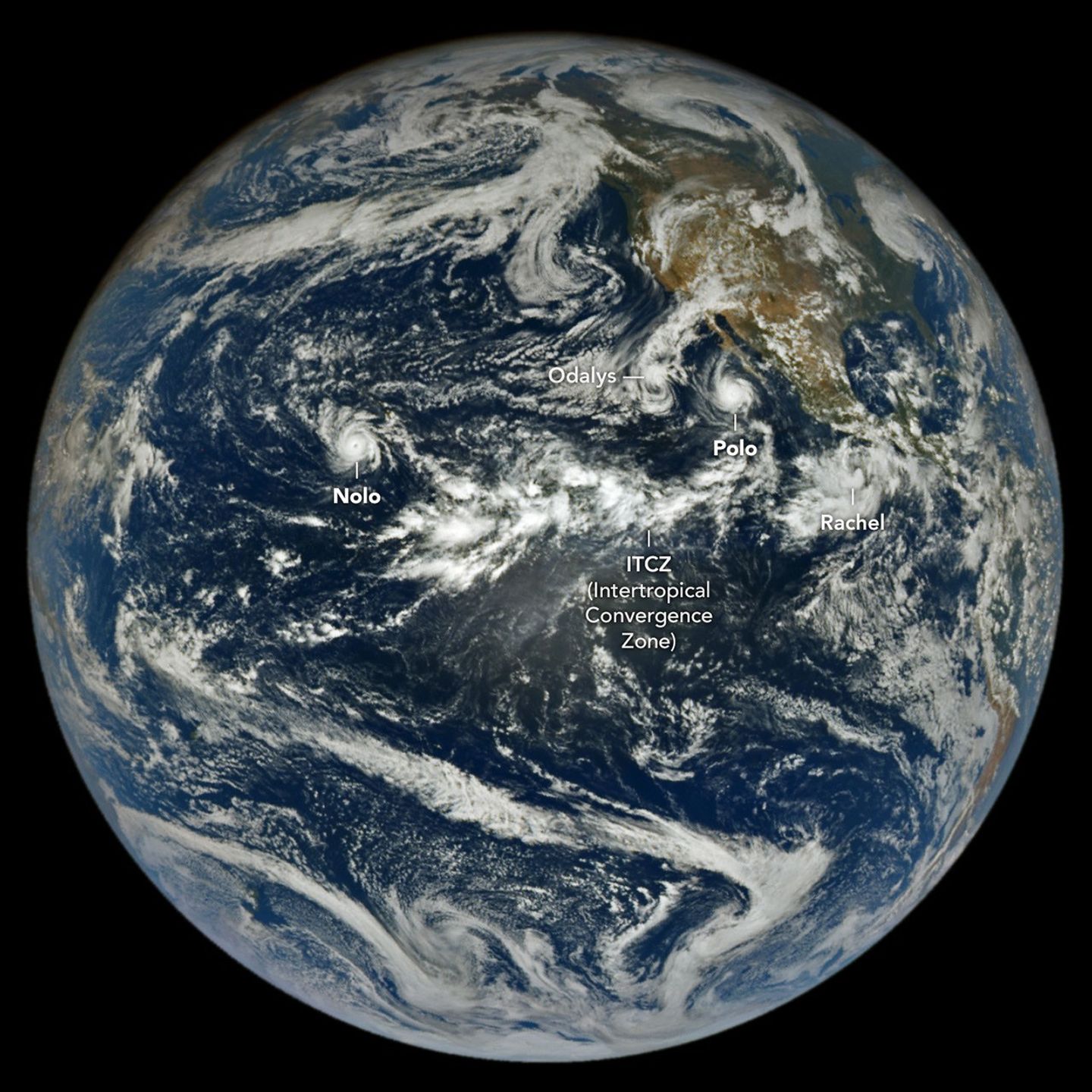
The 2026 tropical cyclone season in the northeastern and central Pacific has been unusually active. By September 28, the region had recorded 20 named storms, nine of which reached hurricane strength, compared with the 1991–2020 average of 13.5 named storms and 7.4 hurricanes by that date. NASA's Earth Polychromatic Imaging Camera (EPIC) on the Deep Space Climate Observatory (DSCOVR) satellite acquired an image on September 27 showing the basin again rife with powerful storms.
At that time, Hurricane Nolo was near Hawaii and Hurricane Polo was off the Baja California peninsula, both lashing land with high winds, storm surge, and heavy rain. On either side of Polo, Tropical Storm Rachel and Post-Tropical Cyclone Odalys were contributing to treacherous conditions along the Mexican coast and in the southwestern U.S., respectively.
Hurricane Polo made landfall in Baja California Sur around 11 p.m. local time on September 28 (06:00 Universal Time on September 29). Before landfall, it underwent extreme rapid intensification over an unusually warm ocean surface and reached category 5 status on September 22; it then weakened on approach and likely made landfall as a category 2 storm, according to the National Hurricane Center.
Polo crossed the peninsula and the Gulf of California and made a second landfall near Guaymas as a further weakened system around midday on September 29. The NHC warned of dangerous winds, storm surge, and heavy rains capable of triggering flooding and mudslides in parts of Baja California Sur and Sonora.
Forecasters expected Polo and its remnants, combined with moisture from Post-Tropical Cyclone Odalys, to push over the southwestern U.S. and southern Plains over several days, fueling more heavy rain and flood risk. Tropical Storm Rachel was tracking parallel to southwest Mexico, where the NHC forecast strong winds and dangerous surf and rip currents.
Hurricane Nolo, the third hurricane of the season to pass close to Hawaii, did not make landfall but dropped more than 12 inches (30 centimeters) of rain on parts of Maui and the Island of Hawaiʻi, flooding roads, toppling trees, and triggering landslides; the Island of Hawaiʻi was spared some of the more severe effects wrought by Hurricane Lala in mid-August. As of September 28, accumulated cyclone energy in the Northeast Pacific was more than twice the norm, according to Colorado State University data.