NASA Telescopes Create Colorful ‘Craft’ From Nearby Nebula
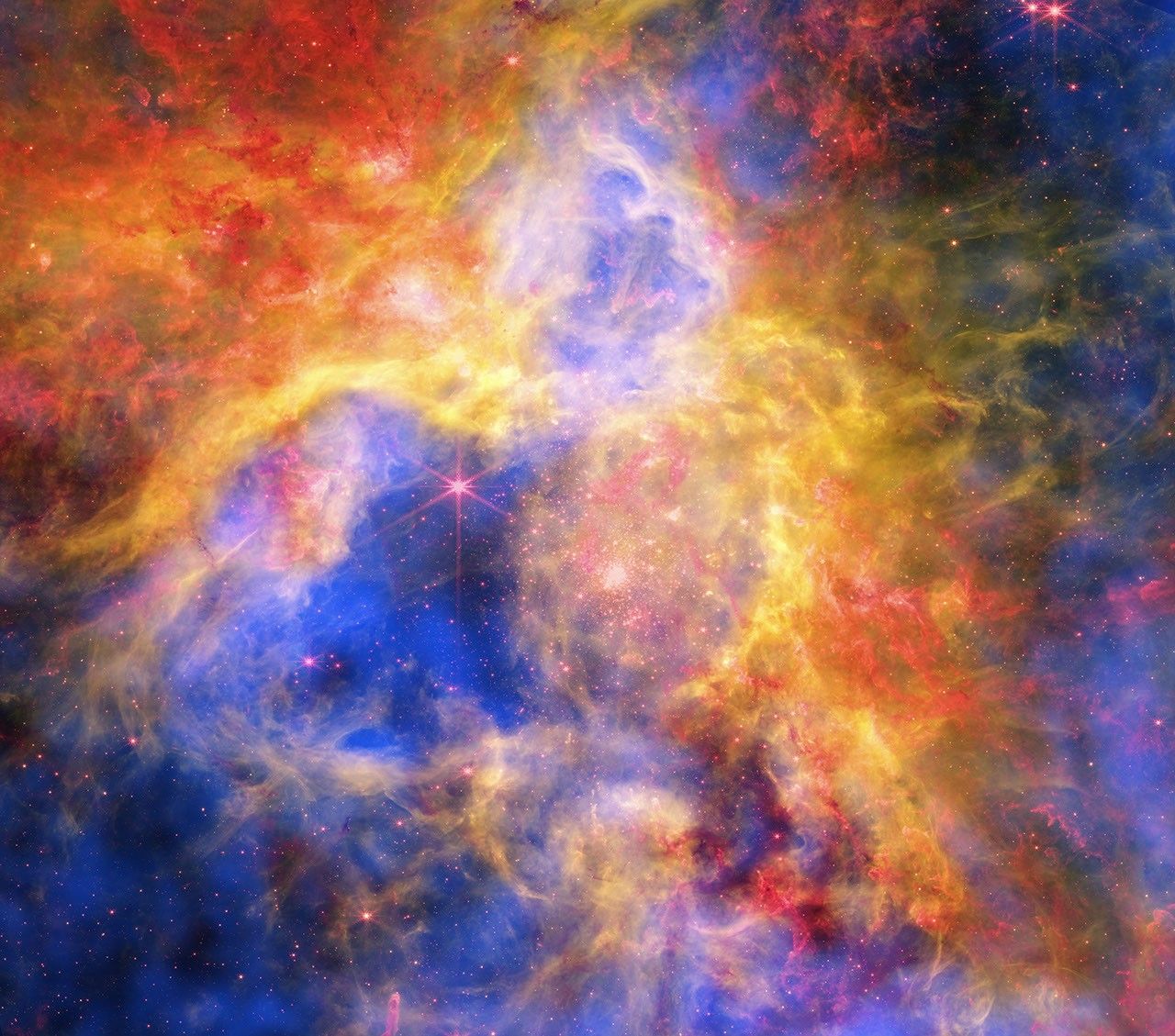
The Tarantula Nebula (30 Doradus) is a star-forming region in the Large Magellanic Cloud, a small galaxy about 160,000 light-years from Earth. It contains thousands of young stars embedded in a honeycomb-like structure of gas and dust. A new composite image layers observations from NASA's Chandra X-ray Observatory (blue), James Webb Space Telescope (red infrared), and Hubble Space Telescope (green optical), revealing details previously hidden in any single wavelength. The X-ray data shows gas blown by winds from young massive stars and heated to millions of degrees by shock waves, while the infrared reveals young stars and cool dust, and the optical highlights warmer hydrogen gas and individual stars. The full image, including data from all three telescopes, was recently published in the Astrophysical Journal.
The research behind the image investigated the energy budget of the nebula. Astronomers had expected that winds from massive stars would heat gas to produce significant X-ray emission, but the observations show much less X-ray-emitting gas than predicted. This led the team to ask: where has the energy gone, and what tamed the Tarantula Nebula? By combining Chandra, Hubble, and Webb data with observations from NASA's retired Spitzer Space Telescope, they concluded the nebula is losing energy through several processes. Up to half of the hot gas is leaking through the shell walls of the gas and dust structures and escaping into the surrounding space. In addition, there is stirring and mixing that further dissipates the energy, though the excerpt cuts off before detailing the remaining mechanisms.